Shopify vs WooCommerce in 2026: Which One Should You Choose?
By Imran Hosain · · 7 min read
Shopify and WooCommerce power a huge share of online stores, and both can work well. The better choice depends on your product, budget, technical comfort and growth plans. I build on both platforms, so here is an honest comparison.
The short answer
- Choose Shopify if you want to launch quickly, prefer not to manage servers or updates, and are mainly selling products.
- Choose WooCommerce if you already run WordPress, need deep customization, or want full ownership and control of your store and data.
What is the difference?
Shopify is a hosted platform. You pay a monthly plan, and Shopify handles hosting, security and checkout infrastructure. WooCommerce is a free plugin for WordPress. You pay for your own hosting, theme and extensions, and you are responsible for keeping everything updated and secure.
Cost
Shopify's cost is predictable: a monthly plan, payment processing fees, and paid apps for extra features. Shopify also charges an extra transaction fee when you use a third-party payment gateway instead of Shopify Payments, so check the current pricing page.
WooCommerce has no license fee, but real costs add up: hosting, a premium theme, paid extensions (subscriptions, bookings, advanced shipping), a security and backup setup, and developer time. For a simple store it can be cheaper, and for a complex store it can cost more. Compare the total for your exact needs, not just the headline price.
Ease of use and setup speed
Shopify wins here. You can have a working store in days. The admin is clean, and checkout is already tuned for conversion. WooCommerce takes more setup, since you choose hosting, configure plugins and manage updates, but it is not hard if you know WordPress.
Flexibility and customization
WooCommerce is more open. Because you control the code and database, you can build almost any custom product type, pricing rule, membership or booking flow. Shopify is flexible through Liquid themes, apps and APIs, but deeper checkout customization is mostly limited to Shopify Plus.
SEO
Both can rank well. WooCommerce, running on WordPress, gives more control over URL
structure, schema and content, and WordPress is strong for blogging. Shopify's SEO
basics are solid, though its URL structure is fixed (for example, product pages always
sit under
/products/ and
collections under
/collections/).
Good content, fast pages and clean structure matter more than the platform.
Performance and security
Shopify is fast and secure by default because it manages the infrastructure. WooCommerce speed depends on your hosting, theme and plugins, and security depends on your updates and setup. A well-built WooCommerce store can be very fast, but it needs ongoing care. See my care plans if you want that handled for you.
Scaling
Shopify scales without you doing server work, which suits fast-growing stores. WooCommerce scales too, but you must upgrade hosting and optimize the database as order volume grows.
Comparison at a glance
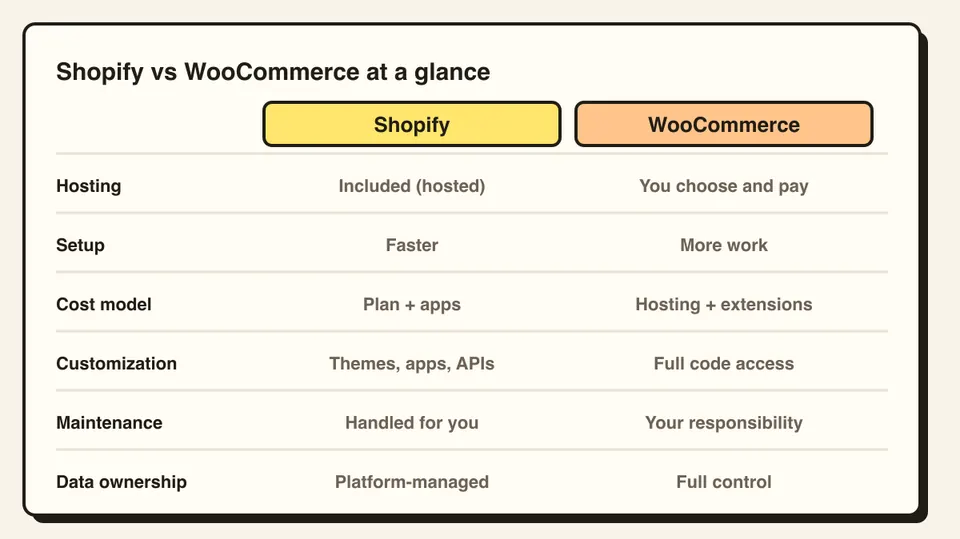
- Setup: Shopify is faster, WooCommerce needs more work.
- Cost model: Shopify is a monthly plan plus apps, WooCommerce is hosting plus extensions plus developer time.
- Customization: WooCommerce is more open, Shopify is more structured.
- Maintenance: Shopify handles it, WooCommerce is on you.
- Content and SEO control: WooCommerce has the edge.
- Data ownership: Full with WooCommerce, platform-managed with Shopify.
My rule for choosing
If the store is the business and you want it running with minimal technical work, pick Shopify. If the store is part of a bigger content or service site, or you need custom behavior that Shopify cannot do cleanly, pick WooCommerce. If you are unsure, tell me what you sell and I will recommend one.
Frequently asked questions
Neither is better in every case. Shopify is better for speed to launch and low maintenance. WooCommerce is better for customization and control.
Yes. Products, customers and orders can be migrated between the two, but design, apps and some URLs need rebuilding, so choose carefully at the start.
Both rank well when built properly. WooCommerce offers more control, while Shopify offers a simpler setup.